Guides
Part of Walking tour companies reviewed for 2027
The eight questions worth asking before booking a walking tour
The questions that separate a good walking tour booking from a bad one, and how to read an operator's answers about access, weather, cancelation and route.
Operators answer questions well or badly, and the difference tells you more than any review. These are the questions worth sending, plus what a good answer looks like, so the reply is readable rather than reassuring.
What to take away
- Ask for numbers: distance, elevation, stop count, group cap, step count.
- Ask what the operator does not control. Honest answers name the street, not the weather.
- Access answers should describe features. An operator cannot promise what the street provides.
- Get the cancelation and weather terms in writing before paying anything.
The eight questions
- What is the total distance and elevation gain?
- How many stops, and how long is the longest one?
- What is the maximum group size, and is it enforced?
- Where does the walk end, and how do people get back?
- What are the surfaces, and are there steps or steep sections?
- What happens in heavy rain, extreme heat or poor air quality?
- What is the cancelation deadline and the refund?
- Who is leading, and how long have they worked here?
Reading the access answers
A good operator describes what is there. A poor one promises accessibility in general terms, which they cannot guarantee, because the street belongs to the city.
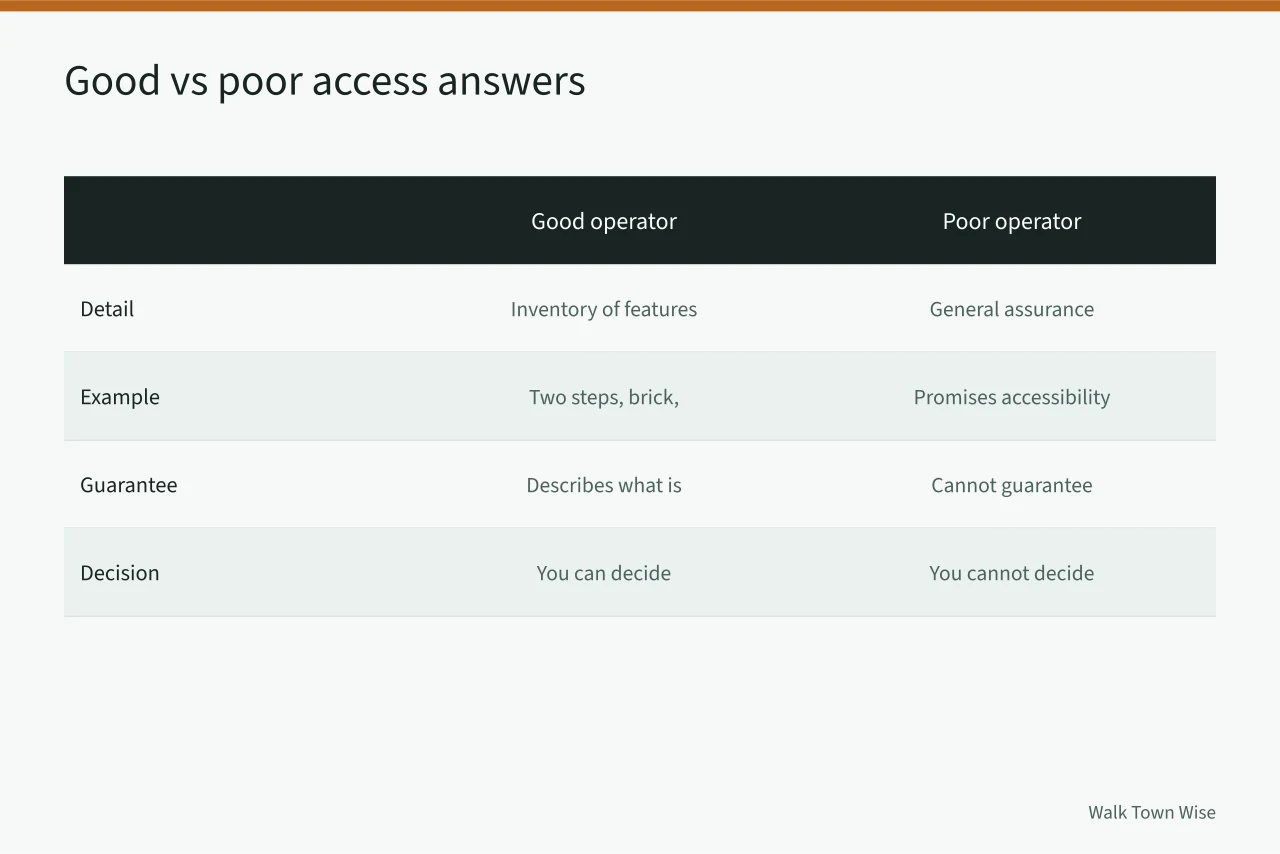
The useful reply reads like an inventory: two steps here, brick there, a bench at this stop and nothing for the next twenty minutes. From that you can decide; from an assurance you cannot.
That distinction is in the rules. The Access Board's rulemaking material on supplementary provisions states that accessibility guidelines for pedestrian facilities in the public right-of-way become mandatory when adopted. That applies with or without additions and modifications, as accessibility standards in regulations issued by other federal agencies under the ADA, Section 504 and the Architectural Barriers Act.
In other words, a guideline is not automatically an enforceable requirement on the street outside.
Buildings on the route are a different matter. The Access Board's guide to new construction under the ABA standards explains how those standards apply to facilities designed, built or altered with federal funds. So a tour that ends in a recently built federal visitor center is on firmer ground than one that ends at a private hall.
| Question | Good answer | Weak answer |
|---|---|---|
| Distance | "2.1 miles, 180 feet of gain" | "A gentle stroll" |
| Group size | "Capped at 12" | "Small groups" |
| Surfaces | "Brick for three blocks, one steep hill" | "Mostly flat" |
| Weather | "We cancel below 20F or in storms" | "We go rain or shine" |
| Access | "Two steps at stop four, seating at six" | "Fully accessible" |
Ask about the poor air day
Extreme heat and smoke now cancel more American walking tours than rain does. Ask specifically: at what point do you cancel, who decides, and what is the refund. An operator with a written threshold has thought about it. One who says they play it by ear has not.
Our guide to what first-timers miss explains why guides are reluctant to cancel, and the booking questions for car-free weekends covers the same discipline applied to the rest of the trip.
Common questions
Is it rude to ask all eight? No. Send them in one message and most operators answer within a day.
What if the answers arrive after I have paid? Then you have lost the useful part. Ask before the deposit.
Should I ask for the exact route? Ask for the start, end and the streets in between. Full route maps are often withheld, reasonably.
How do I judge a brand-new operator? By the specificity of the answers, not the length of the history. A first-season guide who gives you numbers is a better bet than an established one who gives you adjectives.