Features
Part of Walking tour companies reviewed for 2027
Where to stand and what to shoot on a guided walking tour
How to photograph well on a group walking tour: where to stand, what to shoot when the group stops, group etiquette, and how to caption what you shot.
A guided walk is a difficult photographic environment. You do not control the route, the timing, the light or the pace, and fifteen other people are standing where you want to be. The trick is to work with the constraint instead of fighting it.
What to take away
- Walk at the front, shoot from the back. You choose your position, not your route.
- The best frames happen while the guide is talking, not while the group is moving.
- One lens. Changing lenses is how you fall behind and miss the next stop.
- Caption from sources, not from memory. Guide talks are fast and you will misremember.
Position is the whole game
Stay near the front while walking so you can drop back at a stop without falling behind. Once the group settles, move to the edge and shoot past them rather than around them. The group itself is often the best foreground element available, giving scale to a street that would otherwise look empty.
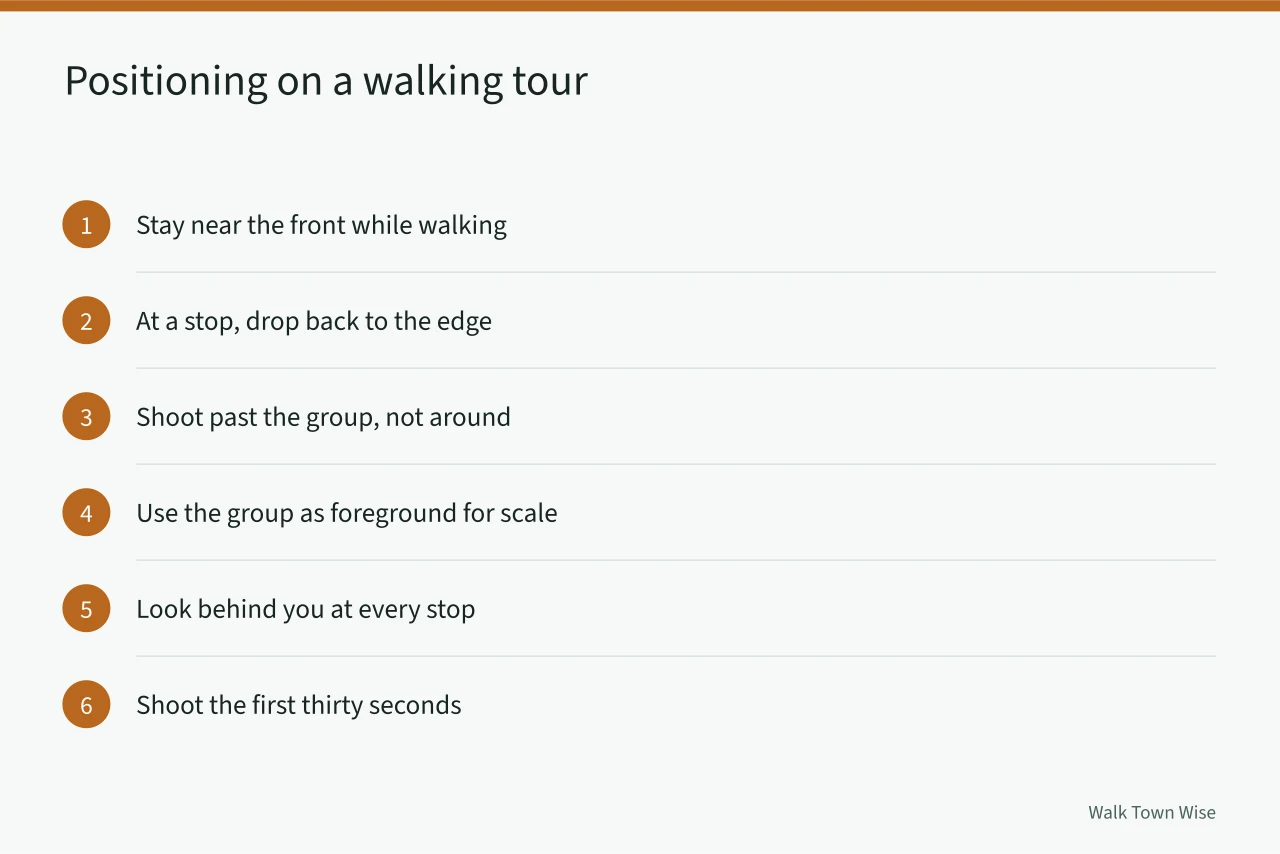
Two habits that pay off. Look behind you at every stop, because the guide is facing the interesting thing and the group is facing away from the second one. And shoot the first thirty seconds of each stop, before people arrange themselves into a semicircle.
What to shoot at each stop
| Stop type | Shot to take | Shot to skip |
|---|---|---|
| Building facade | Detail plus one wide with people | The whole facade, flat and centered |
| Street or corner | The crossing, from the far side | The group listening |
| Interior | Doorway frame, then one detail | Anything needing flash |
| Viewpoint | The view, then people looking at it | Group photograph, unless asked |
Etiquette that keeps you welcome
Do not walk backwards in front of the guide. Do not use a tripod in a moving group. Ask the guide at the start whether photography of the group is fine and whether any stop is off limits. Most say yes to everything and appreciate being asked.
If you want the guide in a frame, ask afterwards. A posed portrait at the end is better than fifteen candid attempts, and they usually agree.
One more courtesy that is also self-interest: keep moving with the group when it moves. A photographer who holds up fifteen people twice becomes the reason the last two stops get rushed, and the last two stops are usually where the walk was going.
Caption from sources
Two hours of a guide talking produces about four facts you will remember and two you will remember wrongly. Check before publishing anything.
For the built environment and the ground under it, EPA's list of EnviroAtlas publications collects reports and papers built on its community-level data. It is a reasonable starting point for anything about tree cover, land cover or ecosystem services in the place you photographed.
For accessibility and street design, the Access Board's list of other resources points to material from bodies including AASHTO, the Federal Highway Administration and the Institute of Transportation Engineers. The Board provides them for information only and makes no warranty about their accuracy.
Our field list for car-free weekends covers the kit for an unguided day, and the guide to what interesting operators do will help you pick a walk worth photographing in the first place.
Common questions
Which lens for a group walk? A 35mm equivalent. Wide enough for streets, tight enough for detail, no changes needed.
Can I photograph other participants? Ask the group at the start. Most people are fine with it if they are asked once.
Should I book the same tour twice? For serious work, yes. The second time you know where the light is.
Is a phone enough? For a two-hour walk with no control over position, often yes.