
Rules
Four Accessibility Mistakes to Avoid in Walkable Towns
Four planning errors that strand travelers in walkable towns, with named examples, the federal rules that apply to streets versus private premises, and who to ask.
Access problems tend to turn up at the door, and they are rarely fixable on the day. A walkable town can still have cobblestones, a steep block, a crossing with no cue for blind pedestrians or a playground reached by a path of loose gravel. Checking before you leave is worth more here than in any other part of trip planning.
This article is about United States law and practice. It names four planning mistakes, the evidence for each, and who can answer the question you actually have. It is not legal advice.
What to take away
- Public streets and private premises sit under different rules. State and local governments fall under ADA Title II. Businesses open to the public, such as hotels and restaurants, fall under Title III.
- The Access Board published its final public right-of-way guidelines (PROWAG) on August 8, 2023. The Board's page shows adoption by GSA and by the Department of Transportation for transit stops, and gives no general enforcement date.
- Boston By Foot rates its Beacon Hill tour at terrain level 3 (0.7 mile, 90 minutes) and its Freedom Trail tour at level 1. Two routes in one city can differ that much.
- Carmel, Indiana reports more than 160 roundabouts. The Access Board's roundabout research says current designs do not give blind and low-vision pedestrians the same crossing information as sighted pedestrians.
- Ask for numberssteps, widths, slopes, surfaces and distances. Keep the answers in writing.
Which rules cover which part of the trip
Different parts of a trip fall under different rules. Sorting them first tells you whom to ask.
| Part of the trip | Who is responsible | What the source says |
|---|---|---|
| Public sidewalks, curb ramps, crossings | City, county or state | New or altered streets and street-level pedestrian walkways must have curb ramps or sloped areas (28 CFR 35.151(i), Title II) |
| Public park and its play area | Public agency | New and altered play areas must meet the play area requirements; the Access Board's play area guide says the guidelines also apply to play areas covered by the Architectural Barriers Act |
| Hotels, restaurants, shops | Private business (Title III) | New construction and alterations follow the 2010 ADA Standards; existing buildings must remove barriers where "readily achievable" (28 CFR 36.304) |
| Historic buildings | Owner | Alterations must comply "to the maximum extent feasible"; if access would threaten historic significance, alternative methods must be provided (28 CFR 35.151(b)(3), 36.405) |
| Private rental houses | Depends on the facts | Lodging counts as a public accommodation, but a facility of not more than five rooms occupied by the owner as a residence is excepted (28 CFR 36.104) |
The 2010 ADA Standards for Accessible Design became mandatory on March 15, 2012 for new construction and alterations. The Access Board's PROWAG address sidewalks, crosswalks, curb ramps and pedestrian signals. The final rule was published August 8, 2023. GSA adopted PROWAG in July 2024, and the Department of Transportation adopted it in December 2024 for transit stops in the public right-of-way. The Access Board's page does not state how or when it applies to ordinary city sidewalks. For that, ask the city's public works department, or the Access Board at row@access-board.gov.
Our guides to curb ramp rules on historic downtown routes and sidewalk width cover the street rules in more detail.
Mistake one: trusting the label
"Accessible" has no fixed meaning in a listing. Ask for figures instead, and keep the replies.
Editorial suggestion: send these five questions before booking anything.
- How many steps are there from the street to the entrance, and how high is each?
- How wide is the narrowest door or passage on the route?
- What is the surfacebrick, cobblestone, gravel, level pavement?
- Is there any slope or hill on the route, and how long is it?
- How far is it from the nearest accessible transit stop?
Operators that publish this detail make it easy. Boston By Foot gives every tour a terrain level (1 for mostly flat, 2 for possible uneven surfaces and moderate inclines, 3 for likely uneven surfaces and significant inclines), and lists the nearest accessible MBTA station. The Preservation Society of Charleston tells guests that tours typically cover six or more blocks, often over uneven streets and sidewalks, and that many sites are not handicapped accessible. Those are the kinds of answers to look for. A reply that only says "yes, accessible" gives you nothing to check.
Mistake two: checking the destination, not the route
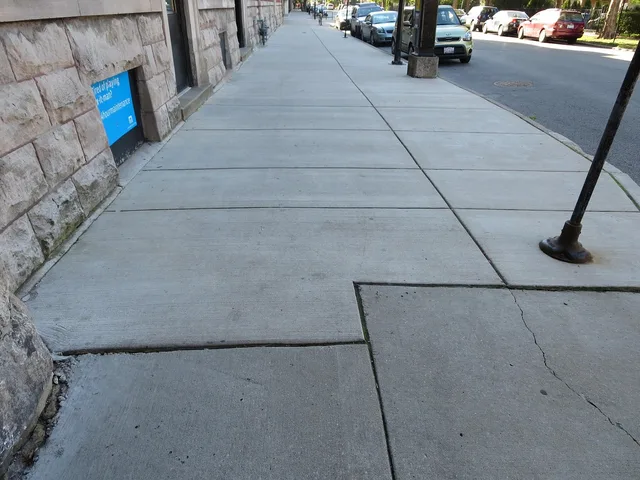
A hotel with an accessible room and a museum with a lift can be separated by four blocks with one missing curb ramp. The connection between them is the part that nobody photographs.
Savannah's Historic District shows both sides of the problem. Visit Savannah, the destination marketing organization, says the flat terrain of the Historic District makes getting around easier for visitors with mobility needs, and says the city has made efforts to improve accessibility, including wheelchair ramps. It lists the DOT Express Shuttle as free transportation. The page does not give surface or curb-ramp detail for specific blocks, so a visitor still needs to ask about the route between a hotel and the squares.
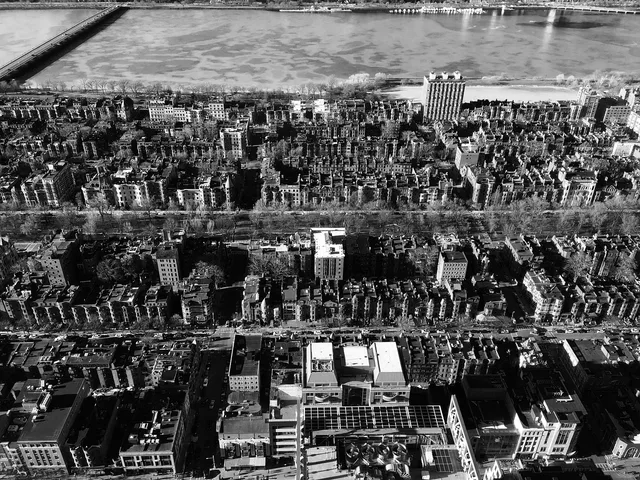
Beacon Hill, Boston, is the opposite case. Boston By Foot says Boston has narrow paths, some brick and cobblestone sidewalks and a few hills. Its Beacon Hill tour runs 0.7 mile in 90 minutes at terrain level 3, while its Heart of the Freedom Trail tour runs 0.5 mile in 60 minutes at level 1. The same city, a few blocks apart, can ask for very different effort.
Historic districts are not simply exempt. Under the ADA regulations, alterations to historic buildings must comply to the maximum extent feasible, and where access would threaten historic significance, alternative access methods must be provided. That is a rule about alterations to buildings. It does not tell you what a particular sidewalk offers today.
Editorial suggestion: check the route in segments. Hotel door to corner, corner to crossing, crossing to entrance. One failed segment fails the route. The hotel sidewalk check on Street View is a quick way to scan a block in advance, and our accessible options guide lists more questions.
Mistake three: assuming a modern crossing is accessible
New roadwork can still leave blind and low-vision pedestrians with less information than others have. The Access Board's roundabout research states that roundabouts are being designed and installed rapidly across the United States, and that current design practice does not give blind and low-vision pedestrians the same access to crossing information as sighted pedestrians.
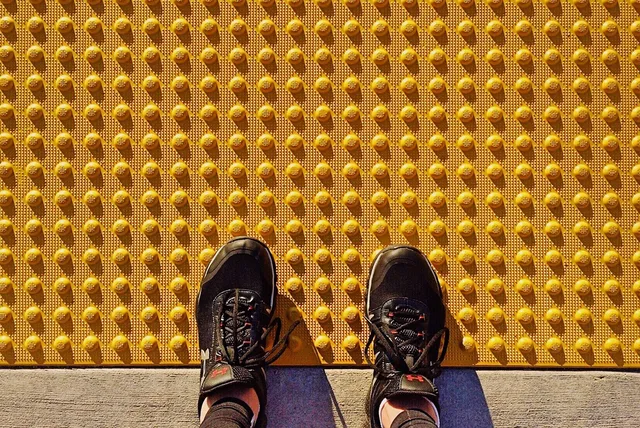
It reports two findings that matter for a visitor. Knowing when to start a crossing is the biggest challenge, because gaps in traffic shrink as volume rises. And preliminary observations at three crosswalks suggest most drivers do not yield to blind pedestrians who are waiting, especially at exit lanes. The page lists what an accessible roundabout would provide: nonvisual information on the location of the crosswalk and splitter island, the direction of crossing, and safe crossing opportunities. It names pedestrian signals (such as HAWK and TOUCAN types), raised crossings and tactile paving among the ideas worth investigating.
The city of Carmel, Indiana says it has more than 160 roundabouts, more than any other US city, and has built them since the late 1990s. A town built around roundabouts is where this check earns its keep.
What to do, in order:
- Ask the city's public works department which crossings on your route have pedestrian signals.
- Where a roundabout has no signal, plan a detour to a signalized crossing. That is an Editorial suggestion, not a rule.
- Allow more time. A detour that adds a few minutes is cheaper than a stranded afternoon.
Mistake four: forgetting that access is not only about wheelchairs
Strollers, small children, older relatives and anyone with a temporary injury need the same route information. Parks are where families meet the problem.
The Access Board's play area guidance says the requirements apply to newly designed or constructed play areas for children ages 2 and older, and to alterations. It sets numbers you can use as a yardstick on a public playground:
- A ground-level accessible route has a 60-inch minimum clear width, which may narrow to 36 inches for 60 inches of length, and a maximum slope of 1:16.
- Surfaces on accessible routes must meet ASTM F 1951 for wheelchair accessibility and be inspected and maintained regularly.
- The play area guidelines do not apply to family childcare facilities where the proprietor resides, amusement attractions or religious entities.
The page does not address private rental properties as a category. If a rental house advertises a play area or garden, ask the host what is there and do not assume it meets any standard.
Who to ask
Question / Who can answer
- Is this crossing signalized? Is the ramp rebuilt?
- City or county public works
- What do the guidelines say about a sidewalk or crossing?
- U.S. Access Board, row@access-board.gov
- What does the ADA require of this business?
- ADA Information Line, 800-514-0301
- Is this route flat, how many steps?
- The tour operator or host, in writing
Sources
- [U.S. Access Board
- Public Right-of-Way Accessibility Guidelines](https://www.access-board.gov/prowag/)
- [U.S. Access Board
- roundabouts, improvements worth investigating](https://www.access-board.gov/research/prow/roundabouts/improvements-worth-investigating/)
- [U.S. Access Board
- play areas guide](https://www.access-board.gov/ada/guides/chapter-10-play-areas/)
- [U.S. Access Board
- ADA Standards overview](https://www.access-board.gov/ada/)
- [U.S. Access Board
- technical assistance](https://www.access-board.gov/ta/)
- [ADA.gov
- 2010 ADA Standards for Accessible Design](https://www.ada.gov/law-and-regs/design-standards/2010-stds/)
- [ADA.gov
- ADA Information Line and topics](https://www.ada.gov/)
- [eCFR
- 28 CFR 36.104, ADA Title III definitions](https://www.ecfr.gov/current/title-28/section-36.104)
- [eCFR
- 28 CFR 36.304, removal of barriers](https://www.ecfr.gov/current/title-28/section-36.304)
- [eCFR
- 28 CFR 35.151, new construction and alterations by public entities](https://www.ecfr.gov/current/title-28/section-35.151)
- [eCFR
- 28 CFR 36.405, alterations to historic properties](https://www.ecfr.gov/current/title-28/section-36.405)
- [Boston By Foot
- accessibility information](https://bostonbyfoot.org/about/accessibility-information/)
- [Boston By Foot
- Beacon Hill tour](https://bostonbyfoot.org/tours/beacon-hill/)
- [Visit Savannah
- accessibility](https://www.visitsavannah.com/accessibility)
- [City of Carmel
- roundabouts](https://www.carmel.in.gov/government/departments-services/engineering/roundabouts)
- [Preservation Society of Charleston
- Fall Tours](https://www.preservationsociety.org/fall-tours/)