Costs
Part of 3 lessons from walkable town case studies
A town's redevelopment stage predicts what your visit will cost
How a town's stage of redevelopment shows up in what a visit costs, which funding streams shaped the district, and how to predict prices before you book.
Two towns with similar populations can differ by half again on the price of a weekend, and the reason is usually visible on a map. Districts that have been through a documented redevelopment cycle price like small cities. Districts still waiting for one price like small towns.
What to take away
- The stage of redevelopment predicts prices better than population does.
- Federal funding follows formulas, so which places get money is not random.
- Newly finished districts are the most expensive. Adjacent blocks are not.
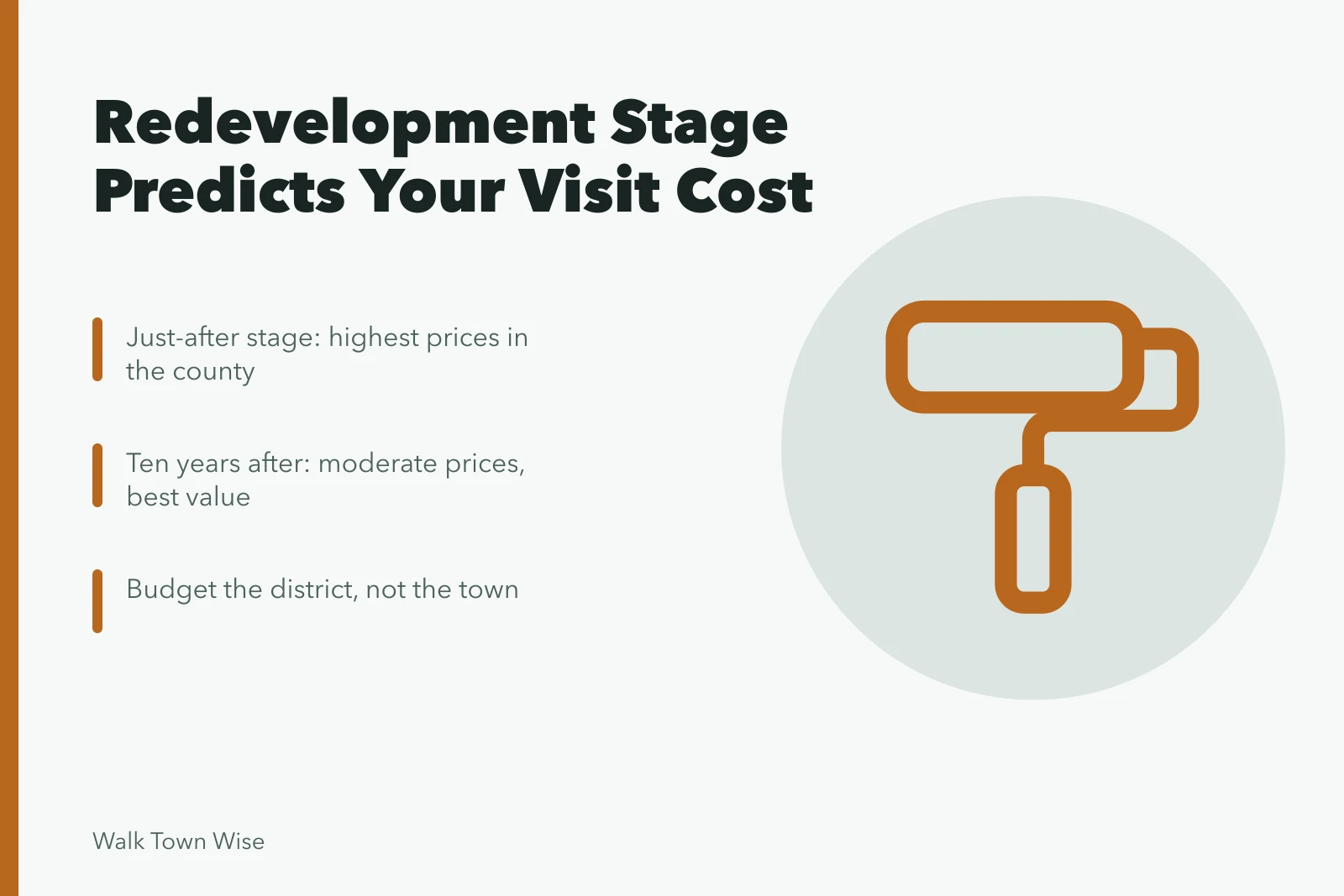
- Budget the district, not the town, because the difference is a few hundred yards wide.
Redevelopment stage, and what it costs you
What you see
- Before
- Empty ground floors, short hours
- During
- Fenced sites, detours, new signage
- Just after
- New hotels, new restaurants
- Ten years after
- Mixed old and new, settled
What it costs
- Before
- Cheap, thin, unreliable
- During
- Cheap, disrupted
- Just after
- Highest prices in the county
- Ten years after
- Moderate, and the best value
The just-after stage catches people out. A district that finished a rebuild two years ago has new lodging, new restaurant pricing and not much competition yet. The same town four blocks over has not changed at all, and often has the better breakfast.
Redevelopment stage vs visit cost
Before
- What you see
- Empty ground floors
- What it costs
- Cheap, unreliable
During
- What you see
- Fenced sites, detours
- What it costs
- Cheap, disrupted
Just after
- What you see
- New hotels, restaurants
- What it costs
- Highest in county
Ten years after
- What you see
- Mixed old and new
- What it costs
- Moderate, best value
The ten-years-after stage is the sweet spot for a visitor. The infrastructure is finished and maintained, the novelty premium has gone, and the mix of businesses has settled into something that serves residents rather than only visitors.
The money is not random
Formulas largely determine where investment goes. HUD's Affordable Housing Programs page describes the HOME Investment Partnerships Program as the largest federal block grant to state and local governments, designed exclusively to create affordable housing for low-income households.
The 200,000 threshold
200,000 | population threshold for direct CDBG funding
Every 3 years | HUD requalifies entitlement communities
Largest federal block grant | HOME funds affordable housing
It is awarded annually as formula grants to participating jurisdictions and can fund building, buying or rehabilitating housing plus direct rental assistance.
Community development money works the same way. HUD's explanation of urban counties says counties in a metropolitan area get Community Development Block Grant funding directly at a population threshold, generally 200,000.
The count excludes populations of metropolitan cities inside them, and HUD requalifies those entitlement communities every three years.
You do not need to follow the details. The takeaway is that a county over that threshold has had a predictable stream of community development money, and its towns usually show it in their sidewalks and streetscapes. Smaller counties compete for the same money through their state instead, which is slower and less certain, and it shows.
None of this is a judgment about which towns are worth visiting. It is a way of predicting what you will find before you get there.
Budget the district, not the town
Because the money lands district by district, so do the prices. A room in the rebuilt block and a room six streets away can differ by a third, and on a walking trip the six streets cost you twelve minutes.
That trade is worth doing deliberately rather than by accident. Our guide to transport, stays and tickets covers how to price the walk against the room, and the case studies pillar explains how to find out what stage a district is at before you book.