Guides
Part of How to think about urban walking gear as of 2027
Assembling walking gear over six weeks instead of the night before
A sequence for assembling walking gear over weeks rather than the night before, how to test each item, and how to read a certification claim honestly.
Almost all bad gear decisions are made in the last week before a trip. The fix is not more research, it is a longer runway. Six weeks is enough to buy four items, test each one properly, and arrive with a kit you already trust.
What to take away
- Buy in order of failure riskshoes first, then socks, pack, shell.
- Test each item on a real walk before the next purchase.
- A certification is a published specification plus independent testing. Most claims are neither.
- Nothing new goes in the bag in the final week.
The six-week sequence
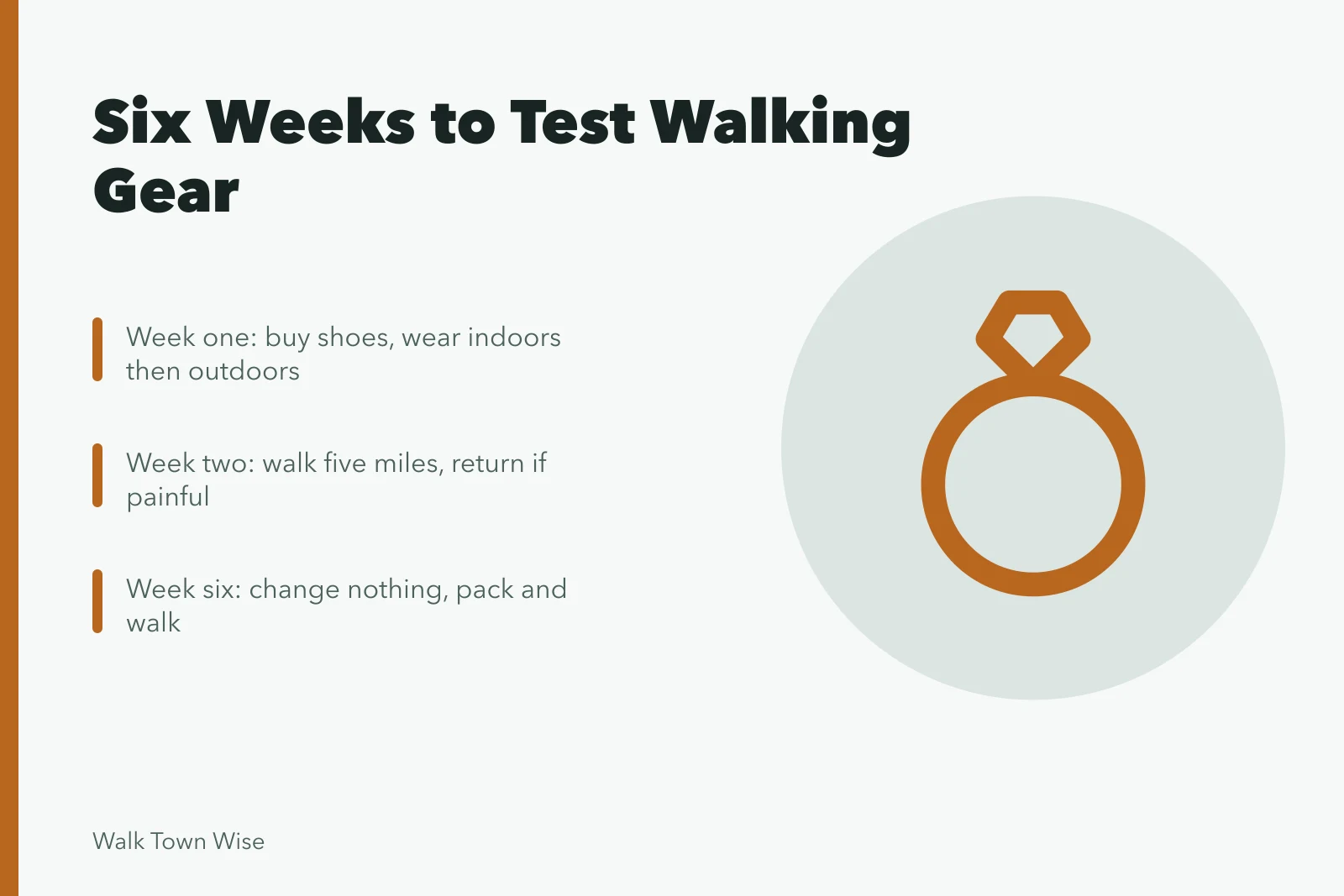
- Week one. Buy shoes. Wear them indoors, then for an hour outdoors.
- Week two. Walk five miles in them. If anything hurts, return them.
- Week three. Buy socks and walk another five miles.
- Week four. Buy or borrow the pack. Walk with it loaded to trip weight.
- Week five. Add the shell. Walk in rain if you can arrange it.
- Week six. Change nothing. Pack, and walk once more with the full kit.
The discipline is in week six. Every item added after the last test walk is an item you will discover on the trip, usually at the least convenient moment, and usually in a way that costs you an afternoon.
Six-week walking gear build
- Week oneBuy shoes, wear indoors and out
- Week twoWalk five miles, return if painful
- Week threeBuy socks, walk five more miles
- Week fourAdd loaded pack at trip weight
- Week fiveAdd shell, walk in rain
- Week sixChange nothing, pack and walk
Six weeks sounds slow, but the walking itself is the part that takes the time. You are not researching for six weeks. You are walking four times in six weeks, which most people do anyway, and buying one thing between each walk.
Read certification claims properly
Outdoor gear is sold with lots of technical language and little verifiable specification. It helps to know what a real certification looks like.
Real certification vs vague marketing
Meaningful claim
- Criterion
- Named standard
- Threshold
- 20% less water
- Verification
- Independent certification
- Label
- Certified label
Marketing description
- Criterion
- No standard
- Threshold
- Unstated
- Verification
- Self-described
- Label
- Premium tag
EPA's WaterSense program is a voluntary partnership and label for water-efficient products. Labeled products and services are certified to use at least 20 percent less water and perform as well as or better than regular models against EPA's published criteria.
That is the shape of a meaningful claim: a named criterion, a threshold, and independent certification against it. Held to that standard, most walking gear marketing turns out to be description rather than specification.
A federal construction standard shows the same pattern in another field. HUD's Office of Manufactured Housing Programs enforces federal manufactured home construction and safety standards under a 1974 Act, inspects factories and retailer lots, regulates installation, and authorizes a certification label for each section of a compliant home.
A label with that much machinery behind it means something. A tag reading premium does not.
| Claim on a label | What to ask |
|---|---|
| Waterproof | To what standard, and for how long |
| Breathable | Measured how, and at what temperature |
| Durable | Repairable, and are spares sold |
| Certified | By whom, against which published criteria |
Test in conditions, not in a shop
Shop-floor comfort is a poor predictor. Feet swell over a few miles, packs feel different at trip weight, and a shell only reveals its hood design in wind. One real walk tells you more than an hour of comparison.
Our pillar on what walking gear earns its price covers which categories reward spending, and the kit cost breakdown covers what the whole set comes to over a year.