Reviews
Part of How to think about urban walking gear as of 2027
How to compare walking tours by the gear they actually demand
How to compare walking tours by the gear they demand: reading a tour listing for what it will require you to carry and wear, using distance, surface.
Difficulty ratings on walking tours mean very little. Easy, moderate and challenging are set by the operator against their own customers, and a moderate three-hour walk in August is harder than a challenging ninety minutes in October. The useful comparison is what the tour will require you to carry.
What to take away
- Ignore the difficulty label. Read distance, surface, duration and exposure.
- Exposure to sun and heat varies within a single town, sometimes sharply.
- A tour with no shade is a different kit from a tour through a park.
- Ask where you can refill water and whether there is anywhere to sit.
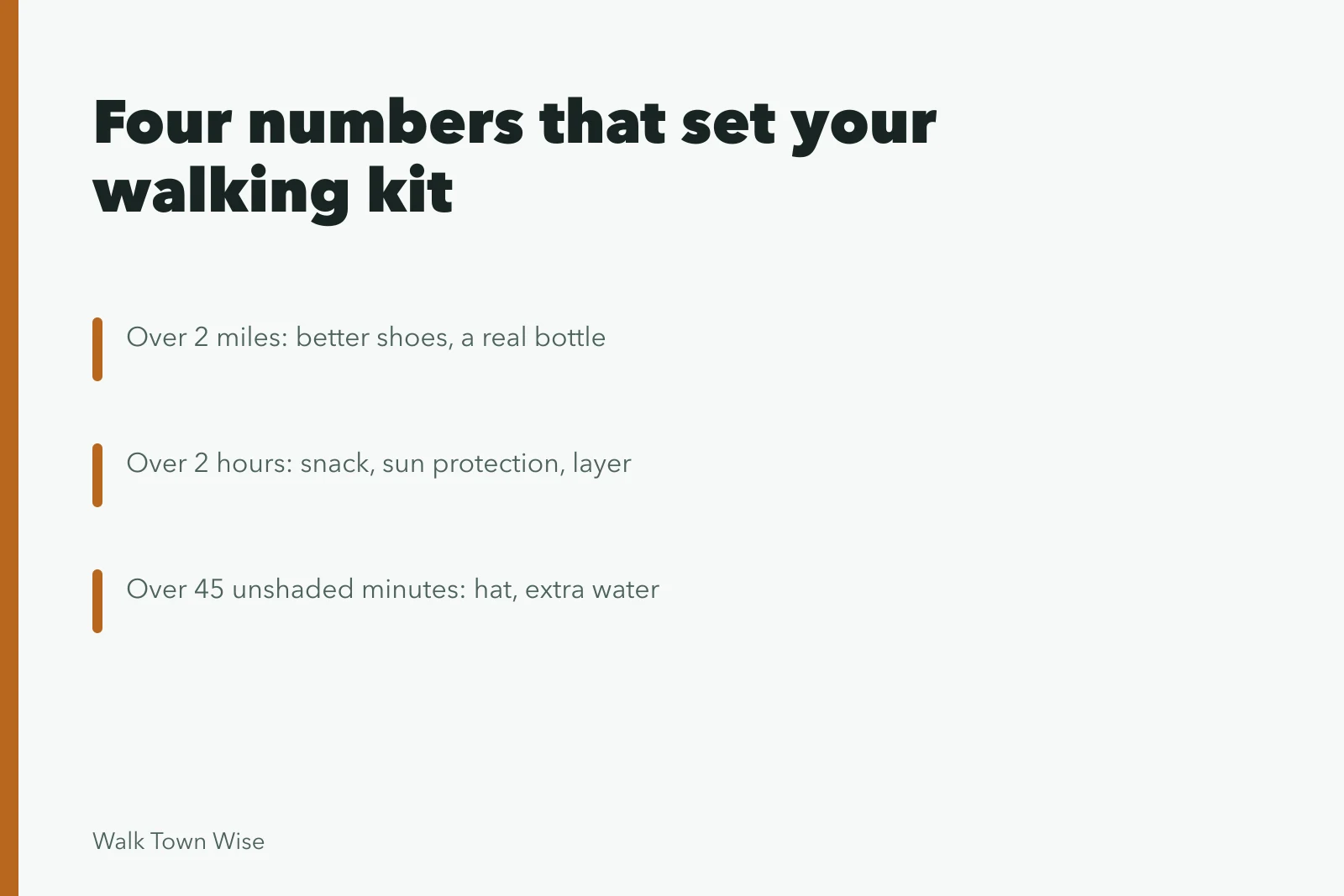
The four numbers that set your kit
Number / Under this, city kit
- Distance
- 2 miles · Better shoes, a real bottle
- Duration
- 2 hours · Snack, sun protection, layer
- Unshaded time
- 45 minutes · Hat, extra water
- Surface change
- None · Stiffer sole if it leaves pavement
Ask the operator for all four. Any tour company that has run its route more than a few times can answer without thinking, and the one that cannot has told you something useful about how often they walk it themselves.
Four numbers that set your kit
Under this: city kit
- Distance
- 2 miles
- Duration
- 2 hours
- Unshaded time
- 45 minutes
- Surface change
- None
Over this: add
- Distance
- Better shoes, real bottle
- Duration
- Snack, sun protection, layer
- Unshaded time
- Hat, extra water
- Surface change
- Stiffer sole off pavement
Exposure is measurable, and it varies block to block
Heat is not uniform across a town. EPA's guidance on measuring heat islands explains how a city finds its hot spots and cooler areas: which geographic area, which times of day and season, and whether to collect air temperatures, surface temperatures or both.
Same length, different heat
Unshaded commercial strip
- Walk length
- Same
- Thermal environment
- Hotter
- Difficulty
- Harder walk
Shaded route
- Walk length
- Same
- Thermal environment
- Cooler
- Difficulty
- Easier walk
It notes the air temperatures that matter sit within the urban canopy, from ground level to the tops of trees and buildings. That is exactly the layer a walker occupies.
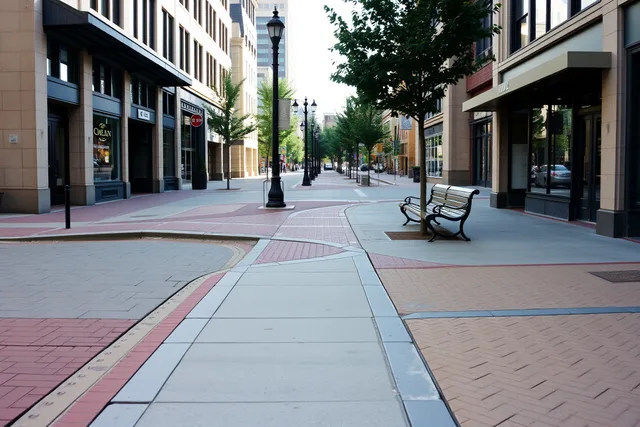
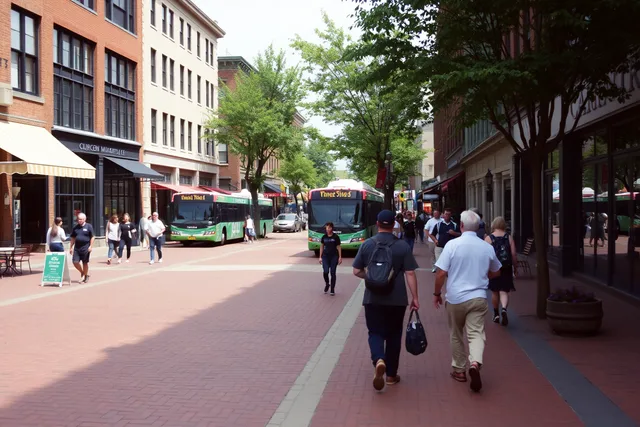
For a tour comparison that matters in a practical way. Two walks of the same length in the same town can sit in different thermal environments, and the one along an unshaded commercial strip is the harder walk regardless of what the listing says.
Check the forecast the operator will not check for you
Sun exposure is forecastable. EPA publishes several UV Index applications, including a searchable forecast by ZIP code, a national contour map of predicted values during the solar noon hour built daily from National Weather Service data, and forecasts three days ahead. Checking that before a long unshaded walk takes thirty seconds.
Tour operators rarely mention it. They are selling the route, not the weather, and most of them run the walk regardless.
Two questions worth asking
Ask where on the route you can refill a bottle, and ask where you can sit down. Operators who know both answers have designed for their customers rather than for the subject. Operators who cannot answer either are describing a route they have walked alone, at their own pace, probably in spring.
Both questions are also polite ways of asking whether the tour is realistic for you without having to explain why you are asking.
Our pillar on what walking gear earns its price covers which items are worth the money once you know what a tour demands, and the routing comparison covers the shape of the walk itself.