Features
Part of How to think about urban walking gear as of 2027
Walking gear maintenance stops: water, repairs and laundry on a long trip
Long trips need laundries, cobblers and water refill points that keep walking gear working, plus towns where the ground changes what your feet need.
Walking gear maintenance stops keep a long trip cheap. Past about four days, gear stops being fixed and starts being maintained. A strap goes, a sole wears through, a shoe soaks.
Two or three planned stops turn those failures into a repair instead of a full-price replacement. Most county-seat towns already have what you need: a laundromat, a cobbler, a public fountain.
What to take away
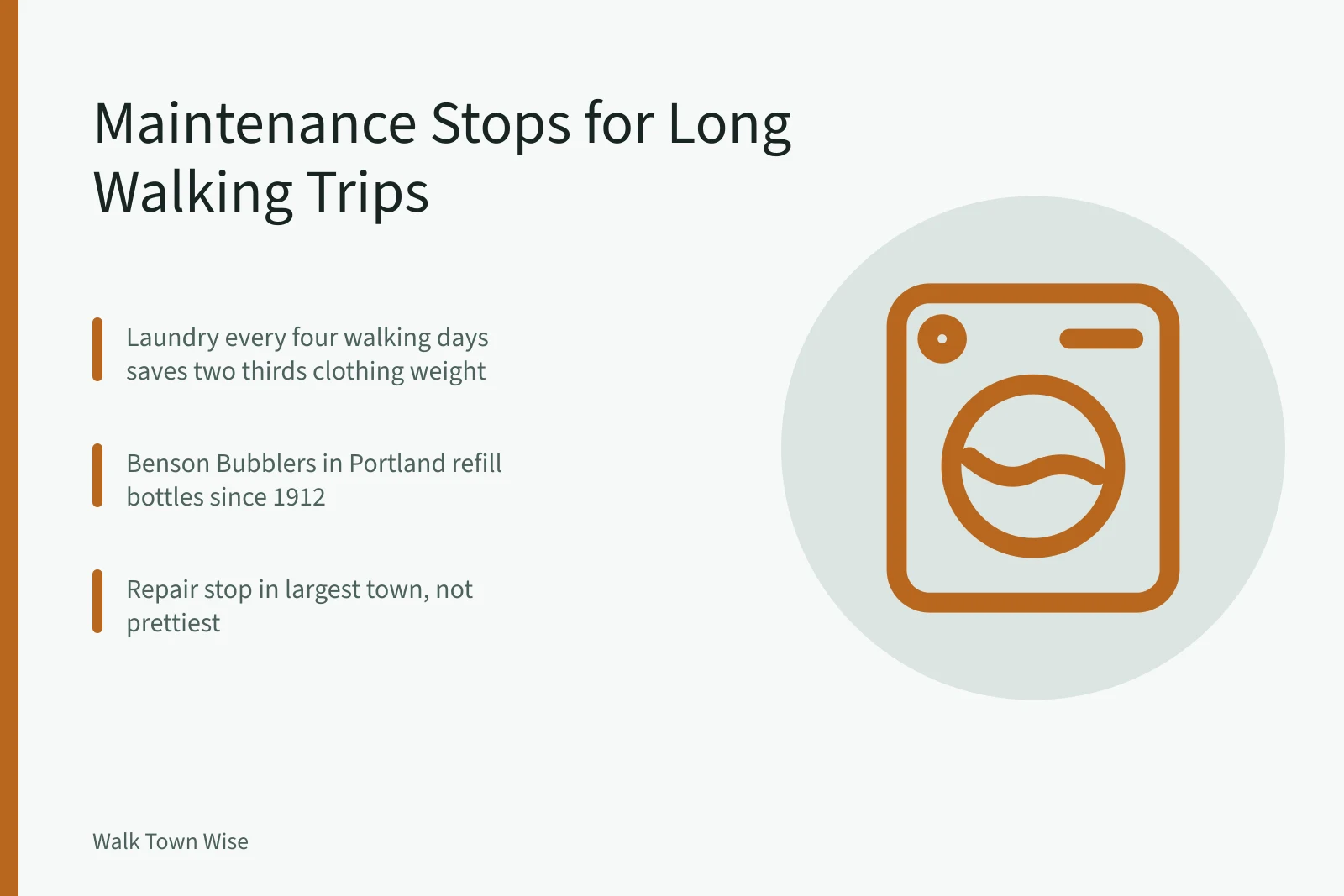
- One laundry stop per four walking days. A wash mid-trip cuts bag weight for every mile before it.
- Refill a bottle instead of buying water. EPA publishes what your local system tests for.
- A cobbler or outdoor repair shop is a cheap detour, but resoling needs days you may not have.
- Reclaimed rail and canal ground changes the shoe. Downtown blocks either side of it do not.
- Put the repair stop in the largest town on the route, not the prettiest.
The four stops, and what each buys you
The four stops
How often
- Laundry (laundromat, Rinse, Poplin)
- Every four walking days
- Water refill (Benson Bubblers, park filling stations)
- Daily, more in heat
- Repair bench (REI, Rainy Pass Repair, NuShoe)
- Once per two weeks
- Rest day (county-seat town)
- Every six or seven days
What it saves
- Laundry (laundromat, Rinse, Poplin)
- Two thirds of your clothing weight
- Water refill (Benson Bubblers, park filling stations)
- Bought bottles
- Repair bench (REI, Rainy Pass Repair, NuShoe)
- A full-price replacement
- Rest day (county-seat town)
- The injury that ends the trip
Laundry is the one people underplan. A single wash halfway through a ten-day trip takes several pounds out of the bag on day one, and you carry those pounds for the first five days. Booking the rest day in a town with a laundromat is a gear decision, not a scheduling one.
Four maintenance stops compared
Laundry
- How often
- Every 4 days
- What it saves
- Two thirds clothing weight
Water refill
- How often
- Daily, more in heat
- What it saves
- Bought bottles
Repair bench
- How often
- Once per 2 weeks
- What it saves
- Full-price replacement
Rest day
- How often
- Every 6-7 days
- What it saves
- The trip-ending injury
Named water, laundry and repair stops
Water. Carry a bottle and refill it. Portland, Oregon has run the Benson Bubblers since 1912, bronze fountains downtown that pour all day.
Grand Canyon and Zion national parks keep bottle filling stations on the South Rim and at the Zion visitor center. New York City Parks maintains roughly a thousand drinking fountains.
The Safe Drinking Water Act of 1974 requires EPA to set and enforce the standards public systems must meet, and roughly 150,000 systems serve most Americans. Your supplier will send a Consumer Confidence Report listing detected contaminants and whether the system passes.
Treat bought water as an occasional convenience, not a daily line in the budget.
Laundry. Rinse and Poplin, the service formerly called SudShare, run app-based wash-and-fold pickup in major cities. Walk-in counters typically charge $1.50 to $2.50 a pound, with a 10 pound minimum.
In county-seat towns the laundromat usually sits within a few blocks of the supermarket. Speed Queen of Ripon, Wisconsin builds most of the machines inside them. Ask at your lodging the night before rather than searching on arrival.
Repairs. A cobbler can stitch a strap or replace a lace hook the same day, typically for $15 to $40. Outdoor shops in trail towns run repair benches; the gear review covers what is worth fixing at all.
REI Co-op stores staff those benches. Rainy Pass Repair in Seattle fixes tents, sleeping bags and jackets by mail. NuShoe in San Diego resoles mailed-in boots, typically in two to four weeks, so plan that before you leave. Ask whether the shop stocks a Vibram sole in your size.
Towns where the ground changes the kit
Former industrial and energy towns are the clearest case. Their walking routes often run on reclaimed ground: old rail alignments, canal banks, works sites turned into parks. EPA's account of its engagement with energy communities describes work with places built around coal, oil, gas or power generation and now redeveloping.
- Jim Thorpe, Pennsylvania.A former coal town. The D&L Trail follows the Lehigh Canal towpath, and the Lehigh Gorge Trail runs on an old rail grade. Crushed stone underfoot.
- Cumberland, Maryland.Western end of the C&O Canal towpath and eastern end of the 150 mile Great Allegheny Passage. Crushed limestone the whole way to Pittsburgh.
- Leadville, Colorado.The Mineral Belt Trail loops about 11.6 paved miles on old railroad grades above 10,000 feet.
- Wallace and Kellogg, Idaho.The Trail of the Coeur d'Alenes runs 73 paved miles on a former Union Pacific line through the Silver Valley mining district.
- Pittsburgh, Pennsylvania.The Great Allegheny Passage ends at Point State Park, and the Three Rivers Heritage Trail follows old steel ground past the Hot Metal Bridge.
- Bethlehem, Pennsylvania.SteelStacks and the Hoover-Mason Trestle sit on the former Bethlehem Steel plant, with the D&L towpath running past.
Expect cinder path, uneven ballast and gravel rather than sidewalk. A stiffer sole and a closed collar make a large difference there, and neither is needed on the downtown blocks either side. Read the surface before you pack the shoe, not after.
Building the stops into the route
Put the laundry stop in your rest-day town and the repair stop in the largest town on the route. Put refill points on the route itself, not in the plan.
Maintenance costs on a long trip
- $4-$8self-service wash and dry
- $70-$120mail-in resole before shipping
- 3fixed maintenance points across two weeks
- 0sightseeing hours lost if stops sit on route
Three fixed maintenance points across two weeks is enough, and none costs a sightseeing hour if it sits where you were stopping anyway. The waypoints guide covers the functional stops that hold a single day together.
A self-service wash and dry typically runs $4 to $8. A mail-in resole typically runs $70 to $120 before shipping.
Transport, beds and tickets decide whether the trip works, and the cost breakdown shows where a laundry afternoon lands against them. If you are booking guided days, the comparison guide covers how operators handle a mid-trip repair.
Common questions
Are laundromats easy to find in small towns?
Usually, and often near a supermarket. Ask at your lodging the night before rather than searching on arrival. A wash-and-fold counter will often turn a load around the same day. In cities, Rinse and Poplin do pickup by app.
Can I get shoes resoled on a trip?
Only with several spare days, and only if the shop stocks your sole. Mail-in shops such as NuShoe in San Diego typically take two to four weeks. Plan resoling before you leave. A cobbler can still fix a strap, a lace hook or a split seam the same day.
Is a spare pair of laces worth carrying?
Yes. They weigh almost nothing, and a broken lace on a Sunday closes the shoe question for the rest of the day. Pack them with the repair kit, not the clothes.
How much water should I carry in a town?
One liter, with the next refill point identified. More than that is weight you lift for no reason. In heat, plan the refill before you need it and check with the local public health authority on conditions. Downtown Portland's Benson Bubblers and park filling stations make the refill free.